First entry in over three years. This is an awkward transition, because in those three years I posted a hell of a lot of content on my MySpace blog. So it looks like I haven't written anything since I was a lowly intern at Echo Park Studios in Bloomington, but that's not the whole truth. I recently re-read some of those MySpace entries, and I'm pretty fond of them, so I recommend going to that blog and catching up, at least back through early 2008.
Actually, reading through all of these, I notice that 2008 seems to have been a pretty interesting and mostly good year, despite getting off to a rocky start. I recall fondly that I wrote quite a bit of music that year (even if not many of them turned into full songs, there are a lot of demos from that year that I still really enjoy), recorded even more of others' music, and I wrote a lot in that blog. So why was most of 2009 such a god damn train wreck? (That's not including the four-month layover in North Dakota, by the way.) Come to think of it, I wasn't too fond of 2007 either.
...Maybe it's something to do with odd-numbered years...
I've been doing a lot of reading lately. I mean, a lot. I have read seven books in the past month. They're mostly books whose names (or whose authors' names) I'm familiar with but had never read and just decided it was time that I did so. For example, Fight Club and Slaughterhouse-Five. I haven't read much in the past week or so, because my mind has been a little distracted. I decided for my latest round of choices I would revisit an old favorite: Tolkien. I'm currently halfway through The Hobbit, and I'm planning to enjoy The Lord of the Rings next. When I read, I often come across certain passages that strike me as particularly beautiful or moving, but I never write them down! I regret that. So I changed that very recently. I wish I had done it sooner, but what can you do. I'm now putting my favorite excerpts from books I read into my Facebook profile. Also, I've considered writing down my opinions on the books I read as I finish them to put online, but I haven't decided if the internet really needs any more opinions.
...Maybe it's because I was single for a majority of 2008...
The journey of teaching myself jazz guitar has also stalled momentarily. Again, it's mostly just because my mind has been distracted for about the last week. Up until this set in, I was making pretty good progress. The last thing I did was transcribe the first chorus of Wes Montgomery's solo in "West Coast Blues". That's about 30 seconds of music. It took me approximately four hours. I didn't realize before I started it that it's actually an incredibly popular solo, and that jazz guitarists frequently use it for audition material, and that ohmygodwhathaveigottenmyselfinto? I don't know that my playing and my ear are advanced enough yet to tackle this, but I'm going to stay on it for the time being. That is, once I pick up my guitar again.
...Maybe there's no connection to anything at all...
I'm actually going to stop this right here. I have a feeling that I could probably keep typing until, oh, the sun rises. And that might actually be a good thing, from a certain point of view. But if I slather my sloppy linguistic excrement all over the place tonight, there will be nothing to save for future updates, and you won't come back to read, and I won't be able to keep my sponsors happy, and they'll revoke sponsorship, and then I'll go broke, and then I'll have to sell my body for cocaine money.
Sunday, February 07, 2010

Saturday, October 14, 2006
Caffibacco
He looked me in the eye.
"I don't have any vices," he said, exhaling smoke.
"I know," I said.
We both slurped noisily from hot mugs of coffee.
This isn't meant to a completed work of sheer wonder. It just popped into my head because it's something that actually happened.
"I don't have any vices," he said, exhaling smoke.
"I know," I said.
We both slurped noisily from hot mugs of coffee.
This isn't meant to a completed work of sheer wonder. It just popped into my head because it's something that actually happened.
Wednesday, October 04, 2006
On the correct use of 'literally'
Let's talk for a bit about the word 'literally'. It's an adverbial form of the adjective 'literal'. Before we delve into literally, let's talk about literal. Forgoing the cliched inlusion of a textbook definition copy/pasted from any number of dictionary-esque websites, suffice it to say that literal means 'true to the meaning of words'. The opposite would be figurative, in which words have secondary meanings that may or may not be easily understood. From this definition of literal, we can then define literally as 'being used in a strict sense without exaggeration'.
The use of literally, however, has evolved in modern times with a sense of adding great intensity to a statement. I would like to narrow it down and say that literally, when used in such a way, means precisely the following: the statement, though seemingly exaggerated, is completely true. The problem recently is that two incorrect uses have begun to crop up, one of which directly contradicts the meaning of the word; the other is merely redundant and unnecessary.
Problem #1: Directly contradicts the meaning of the word.
"I'm so hungry, my stomach is literally eating itself." "She broke his heart. He was literally crushed." Today is hot; it's literally a thousand degrees outside."
The problem with using literally in this way is that none of it is literal at all. Literal would mean that the stomach has, in fact, eaten itself and no longer remains, or that the body was actually demolished, or that the thermometer reads one thousand degrees. None of these is true. They are not literal, they are figurative.
Problem #2: Redundant, unnecessary.
"In 1492 Columbus literally sailed across the ocean."
Obviously the problem here is that the statement is clearly fact and there has been absolutely no exaggeration. It is not important to remind the reader/listener of the truth of the statement. If we would find it difficult to believe that someone could sail across the ocean, or if we were led to believe that the entire ocean was not sailed, then literally would perhaps be used as a reminder of the validity of the statement, or against claims of exaggeration. As it is, it's just completely useless.
Words evolve and change, it's true. But using a word that is still in common usage in a completely opposite manner is debilitating to language. If you ask me how I feel and I say "terrible" would you be concerned? But what if I meant 'great' when I said 'terrible'? Would you be confused? How about the next time you ask me and I say "great"? Does that now mean 'terrible' or does it still mean 'great'? We should probably agree on what the words mean and then stick to it, so we are able to understand each other better next time.
Thanks for reading. Have an awful day.
The use of literally, however, has evolved in modern times with a sense of adding great intensity to a statement. I would like to narrow it down and say that literally, when used in such a way, means precisely the following: the statement, though seemingly exaggerated, is completely true. The problem recently is that two incorrect uses have begun to crop up, one of which directly contradicts the meaning of the word; the other is merely redundant and unnecessary.
Problem #1: Directly contradicts the meaning of the word.
"I'm so hungry, my stomach is literally eating itself." "She broke his heart. He was literally crushed." Today is hot; it's literally a thousand degrees outside."
The problem with using literally in this way is that none of it is literal at all. Literal would mean that the stomach has, in fact, eaten itself and no longer remains, or that the body was actually demolished, or that the thermometer reads one thousand degrees. None of these is true. They are not literal, they are figurative.
Problem #2: Redundant, unnecessary.
"In 1492 Columbus literally sailed across the ocean."
Obviously the problem here is that the statement is clearly fact and there has been absolutely no exaggeration. It is not important to remind the reader/listener of the truth of the statement. If we would find it difficult to believe that someone could sail across the ocean, or if we were led to believe that the entire ocean was not sailed, then literally would perhaps be used as a reminder of the validity of the statement, or against claims of exaggeration. As it is, it's just completely useless.
Words evolve and change, it's true. But using a word that is still in common usage in a completely opposite manner is debilitating to language. If you ask me how I feel and I say "terrible" would you be concerned? But what if I meant 'great' when I said 'terrible'? Would you be confused? How about the next time you ask me and I say "great"? Does that now mean 'terrible' or does it still mean 'great'? We should probably agree on what the words mean and then stick to it, so we are able to understand each other better next time.
Thanks for reading. Have an awful day.
Thursday, January 19, 2006
No pun intended
Use of the phrase 'no pun intended' is typically reserved for specific instances in which a pun has been made, whether intentionally or unintentionally. It is quite clear to the listener (or reader) that the pun is there and any sort of comical results are, by this point, unavoidable. It is hereby encouraged that orators and writers begin use of the phrase 'no pun intended' at specific times when no pun has been made whatsoever. A few good examples of this updated manner of use in everyday conversation might be:
"Did you hear about the rabbi who bought a used Mercedes Benz? He got leather upholstered seats. No pun intended."
"I don't know why Sarah took her dog back to the pet store; it was a perfectly good terrier. No pun intended."
"What great weather we have today, it didn't snow or rain. No pun intended."
This will be a welcome assurance for the audience, who can easily be confused by the presence of both the pun itself and the words 'no pun intended.' Immediate and thorough adoption of this new method is suggested for all communicators, both of word and voice. A streamlined and easily understandable conversation is a good conversation, no pun intended.
"Did you hear about the rabbi who bought a used Mercedes Benz? He got leather upholstered seats. No pun intended."
"I don't know why Sarah took her dog back to the pet store; it was a perfectly good terrier. No pun intended."
"What great weather we have today, it didn't snow or rain. No pun intended."
This will be a welcome assurance for the audience, who can easily be confused by the presence of both the pun itself and the words 'no pun intended.' Immediate and thorough adoption of this new method is suggested for all communicators, both of word and voice. A streamlined and easily understandable conversation is a good conversation, no pun intended.
Wednesday, January 18, 2006
Ben Folds
from Rock Music Review (www.rockmusicreview.com)
Ben Folds (website / MySpace)
Songs for Silverman (2005)
Reviewed by Andrew Malott (link)
Ben Folds (website / MySpace)
Songs for Silverman (2005)
Reviewed by Andrew Malott (link)
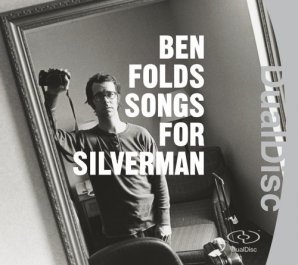
While the band does have a few opportunities to really rock out together, on the whole it sounds quite reserved. The familiar rhythm section of piano, drums, and bass is still intact and mostly unchanged throughout the majority of the album; there is a cello here and a guitar there, but they are few and far between. Compared to the highly produced Suburbs, complete with synthesizers, electric guitars, and harmony abound, Silverman feels stripped down. This is no doubt intentional as a production decision, to reflect the more introspective nature of the album and let the songwriting take center stage, but as a result the album is a little more low-key than past offerings. This feeling is only furthered by Folds’ singing, which sometimes sounds tired and weary, instead of bursting out of the speakers with life.
In the first track, “Bastard,” Folds evokes the cynicism of an old man. Although the lyrics are entirely in the third person, it seems as though he is singing about himself. Marked by interesting meter changes, this song stands out as the longest and most varied of the album. Following this is “You to Thank,” which has great lyrics and an incredible jazzy piano solo at the bridge that will perk the ears of seasoned fans. Unfortunately, it lacks a strong, memorable chorus to complement Folds' piano mastery. He returns to the cynical theme later in the album in “Sentimental Guy.” The swaggering, swung rhythm and beautifully dissonant chords of the chorus are very charming, and this simple song manages to work.
“Landed,” released as a single in February, is a combination of the best of Folds’ talents at this stage in his life. The chords are beautiful, the melody is memorable, and the lyrics are touching; it’s one of the best tracks on the album. “Give Judy My Notice,” a candidate for another radio single, is a reworking of a song from Folds’ 2003 EP Speed Graphic, this time with drums, bass, and a bit of slide guitar. Unfortunately, this remake pales deeply in comparison to its predecessor and any fan of Ben Folds is strongly urged to listen to a copy of Speed Graphic to hear the song at its finest.
“Jesusland” is Folds at his sharpest as he takes shots at urban America. This isn’t a far cry lyrically from his live show favorite “All U Can Eat,” from the Sunny 16 EP, although here he addresses the subject with a bit more class.
More touching and meaningful than any other song on the album is “Late,” a tribute to the late singer/songwriter Elliott Smith. It gives “Landed” a run for its money as best song on the album.
Ben Folds has earned a reputation for making the music he wants to make when he wants to make it, and Songs for Silverman is certainly no exception. Eschewing past formulas for success, Folds has chosen to write songs about the things he cares about, not what he cared about ten years ago. Nothing on the album is actually anything less than good, but taken in the context of Ben Folds’ decade-long history, it’s hard to measure up.
7.5 / 10
The difficulty of acquiring my morning grits
Dear Producers and Distributors of Edible Goods,
Please stop making your products so damn hard to open. You know the bag that resides snugly within the cardboard carapace of the cereal box? You don't need to seal that off with cement. Any standard grade adhesive will do. If I am forced to resort to the use of serated cutting utensils, then you've outdone yourselves.
Please stop making your products so damn hard to open. You know the bag that resides snugly within the cardboard carapace of the cereal box? You don't need to seal that off with cement. Any standard grade adhesive will do. If I am forced to resort to the use of serated cutting utensils, then you've outdone yourselves.
Monday, December 12, 2005
Margot and the Nuclear So and So's
from Rock Music Review (www.rockmusicreview.com)
Margot and the Nuclear So and So’s (website / MySpace)
The Dust of Retreat (2005)
Reviewed by Andrew Malott (link)
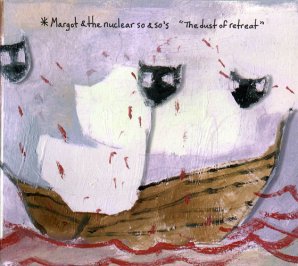
Margot and the Nuclear So and So’s deftly combine sounds of folky acoustic guitar, driving electric guitar, smooth cello, and catchy piano to create a wonderfully unique sound. Singer/songwriter Richard Edwards, formerly of the band
The first two tracks “A Sea Chanty of Sorts” and “On a Freezing Chicago Street” pass by without a big, catchy chorus, but they are no less important in their own right, nor are they altogether without any hooks to speak of. Both are exemplary of Richard’s uncanny ability to write songs that are catchy and undeniably pop, but unique enough to be called indie. The fourth track “Quiet as a Mouse” stands out in that it is the only song on the album to feature a truly rocking chorus. Distorted power chords and soaring vocal melodies are a nod back to Richard’s days with
Songs like “Jen Is Bringin’ the Drugs” and “A Light on a Hill” are wonderful showcases for Richard’s singer/songwriter roots. With lyrics like “Love is an inkless pen / It’s a tavern, it’s sin / It’s a horrible way to begin,” he’s no stranger to the loved-and-lost formula, but he avoids it and only hints at subjects other singers might have come right out and said. Richard’s use of metaphor is both highly romanticized and mysterious; he leaves out the details for the listener to fill in. On “Vampires in Blue Dresses,” “Barfight Revolution / Power Violence,” and “Skeleton Key,” the band really gets a chance to have some fun; they serve as a great contrast to the quieter, pensive mood of some of the other tracks like “Dress Me Like a Clown” and “Talking in Code.” With jingling bells and a sweet, descending piano melody, the final song “Bookworm” brings the album to a satisfying close.
Technically, the album represents a watermark for producer Tyler Watkins, who is also the bassist of the band. Every track is easy to listen to with an even frequency spectrum and balanced highs and lows. The loud parts are loud and rocking, while the softer parts have just the right amount of compression to bring out the intricacies of the performance while still retaining enough dynamic sway.
The talented musicians of Margot and the Nuclear So and So’s have a bright future ahead of them with a great debut album to boot. It will be a shame if future listeners, lured in by the band’s ever increasing popularity, never have the pleasure of hearing this album. It will be an even bigger shame if the band’s sound is waxed over by the suits of the recording industry in hopes of making even more money. Hopefully Richard and the band have enough wits about them to keep their musical integrity in highest priority as they start to show up on the big scene.
9.0 / 10.0
Thursday, December 01, 2005
The precise reason that religion is bullocks
Recently, the Catholic church has been debating the possibility of doing away with the concept of limbo. For the uninitiated, this is the realm in which unbaptized but innocent souls (like babies or those who lived before Jesus did his thing) go when they die; not quite heaven and not quite hell. Its etymology is of Latin descent, from limbus, and it originally meant the border of hell. This was a great concept to sedate the minds of the earthly survivors, who feared that their lost loved ones were suffering in an eternal sea of fire.
Now it seems that this age-old theory is about to be debunked -- by the same group of people who devised it centuries ago. The good ol' boys of the Catholic church have been gathering up in their tree house to determine what to do about the situation. Their former ring leader Pope John Paul even expressed his own desire to remove the concept of limbo from the church before he died. What's going to replace it? Maybe babies who die during childbirth do go to hell.
The fact that these guys can just decide to do away with a concept like, oh, where someone's soul goes when he or she dies, is just the kind of thing that helps shatter the very foundation of their credibility. If there is a god, he's probably looking on and laughing at all of his silly little Catholics, rewriting this and modifying that until life is easy to live again. It's a simple fact that times change and so do standards; thankfully, the Bible changes too. I'm sure if you wait around long enough, it will eventually change enough to fit your standards too. That seems to have been the motto of any significant church movement in recorded history: Don't like what they teach? Rewrite it.
Remember that election a year ago, when a country's faith in a presidential candidate was shaken because of an indecisive streak? The church is no different, except it's been changing its mind for almost two thousand years. How can something be true if all it takes is a meeting with couple of stodgy old guys to change it every now and then on a whim?
If next year they claimed that hell doesn't exist, would Catholics the world over believe and accept it?
http://news.yahoo.com/s/nm/20051130/od_nm/pope_limbo_dc
Now it seems that this age-old theory is about to be debunked -- by the same group of people who devised it centuries ago. The good ol' boys of the Catholic church have been gathering up in their tree house to determine what to do about the situation. Their former ring leader Pope John Paul even expressed his own desire to remove the concept of limbo from the church before he died. What's going to replace it? Maybe babies who die during childbirth do go to hell.
The fact that these guys can just decide to do away with a concept like, oh, where someone's soul goes when he or she dies, is just the kind of thing that helps shatter the very foundation of their credibility. If there is a god, he's probably looking on and laughing at all of his silly little Catholics, rewriting this and modifying that until life is easy to live again. It's a simple fact that times change and so do standards; thankfully, the Bible changes too. I'm sure if you wait around long enough, it will eventually change enough to fit your standards too. That seems to have been the motto of any significant church movement in recorded history: Don't like what they teach? Rewrite it.
Remember that election a year ago, when a country's faith in a presidential candidate was shaken because of an indecisive streak? The church is no different, except it's been changing its mind for almost two thousand years. How can something be true if all it takes is a meeting with couple of stodgy old guys to change it every now and then on a whim?
If next year they claimed that hell doesn't exist, would Catholics the world over believe and accept it?
http://news.yahoo.com/s/nm/20051130/od_nm/pope_limbo_dc
Monday, November 14, 2005
A practical application of mutual incurred loss in a spatial, finite distribution
If two bodies are separated by a distance X, let X be divided into any number of finite segments such that X = A + B + C + ... + N, for which all values are positive, rational numbers. If X > 0, both parties suffer the mutual incurred loss of the 'Equal but Opposite Bodies' theorem, as outlined here by the author on 15 February 2005. Furthermore, let T = time of separation between bodies. The mutual incurred loss will be proportional to (X + T)².
Sunday, October 23, 2005
Financial concerns
Greetings Cradle-goers,
It's been over half a year since we last talked but something's come to my attention that I'd like to bring up. Below you see what appears to be an innocent person carrying an inconspicuous book on a nondescript street.

Click for full size
If you look closer, however, you'll find out that there's much more to the scene than you thought. This poor individual has been the victim of an unfortunate agenda to rid the contents of his wallet and bank account. At a cursory glance, you might be tempted to believe that he is of lower-middle class status, perhaps a college student getting by on minimum wage and federal grants. Let your eyes wander to the bottom and you will observe what appear to be descriptions and prices of various clothing garments, all of which adorn our street-crossing urchin. It is at this point that you will make the horrifying discovery that he is actually filthy rich and has spent in excess of $300 on pants. Jeans. Denim.
His entire outfit costs $484, not including the "vintage hat and scarf," which are listed as not available. What? Is that the only item that Urban Outfitters hasn't bought from Goodwill and then marked up the price 100 times higher? I've got a pair of corduroys with frayed edges, ripped hems, and a hole in the pocket, and you can buy them from me for $300. No wait, $150. Actually, I think I won't sell them; I've had them for over 4 years and I enjoy wearing them. So if you want to look as cool as me, you're going to have to do what this poor bastard did: spend nearly two weeks' pay on a pair of dingy pants.
Tune in next time to see if he makes it across the street. I'm hoping he doesn't.
It's been over half a year since we last talked but something's come to my attention that I'd like to bring up. Below you see what appears to be an innocent person carrying an inconspicuous book on a nondescript street.

Click for full size
If you look closer, however, you'll find out that there's much more to the scene than you thought. This poor individual has been the victim of an unfortunate agenda to rid the contents of his wallet and bank account. At a cursory glance, you might be tempted to believe that he is of lower-middle class status, perhaps a college student getting by on minimum wage and federal grants. Let your eyes wander to the bottom and you will observe what appear to be descriptions and prices of various clothing garments, all of which adorn our street-crossing urchin. It is at this point that you will make the horrifying discovery that he is actually filthy rich and has spent in excess of $300 on pants. Jeans. Denim.
His entire outfit costs $484, not including the "vintage hat and scarf," which are listed as not available. What? Is that the only item that Urban Outfitters hasn't bought from Goodwill and then marked up the price 100 times higher? I've got a pair of corduroys with frayed edges, ripped hems, and a hole in the pocket, and you can buy them from me for $300. No wait, $150. Actually, I think I won't sell them; I've had them for over 4 years and I enjoy wearing them. So if you want to look as cool as me, you're going to have to do what this poor bastard did: spend nearly two weeks' pay on a pair of dingy pants.
Tune in next time to see if he makes it across the street. I'm hoping he doesn't.
Subscribe to:
Posts (Atom)

